I continue to build my ultimate ranking of U.S. presidents, and after a day of reading, James K. Polk is moving rapidly up the list.
Polk entered the presidency with a remarkably clear ideas of what he wanted to accomplish. He announced early that he would serve only one term, then did exactly that. During those four years, he pursued his agenda with determination, expanded the United States dramatically, and delivered on many of the objectives he had set himself.
What strikes me most is the focus. One term, a defined programme, then action and results. A rather different approach from the political careerism we often see today.
Polk was also a relatively low-profile president. It was during his presidency that “Hail to the Chief” became closely associated with the president’s entrance, reportedly because his wife Sarah wanted people to notice when he entered the room.
Only a few months after leaving office, exhausted after years of hard work, James K. Polk died at the age of 53.
I’m reading a book about every President of the United States and creating my own ultimate ranking. I haven’t made my way through all of them yet, as I’m reading the chapters in random order.
So far, President Ronald Reagan remains the undisputed champion of my list. But President Lyndon B. Johnson is a fast mover, climbing the rankings with every chapter.
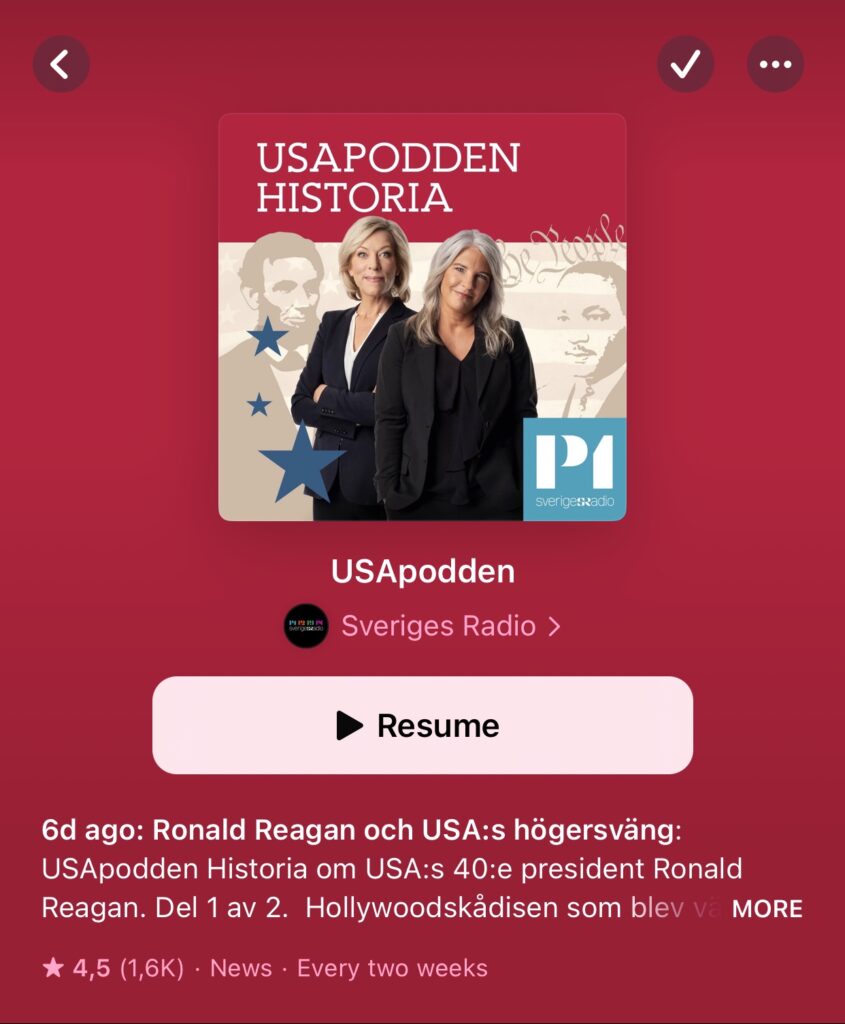
For several years, Swedish public service has closely followed American politics through a well-produced podcast series. This format has now expanded to cover American history, and today it touches upon my favorite president, Ronald Reagan.
Reagan was a masterful communicator who adeptly tailored his message to suit the times and the media, while effectively implementing his vision. Effective political communication is anchored in a clear, localized vision that is personally delivered to potential voters in their daily lives. Success comes from being able to convey presence, relate to realism, provide immediacy, and offer perceptual density — all of which Reagan achieved. He also excelled at conceptualizing and packaging main topics using almost Hollywood-style introductions, such as his references to the “evil empire” and initiating a “Star Wars” defense strategy through effective communication, which led a major eastern empire to nearly bankrupt itself in an arms race.
As a communicator in the business world, I’m inspired by his method of crafting impactful messages that grow in value.